Best AI Content Checkers in 2026 (Free Tools Included)
A hands-on comparison of the 7 best AI content checker tools in 2026. Includes pricing, accuracy data, and free options like Slop Detector, GPTZero, and ZeroGPT.

Best AI Content Checkers in 2026 (Free Tools Included)
An Ahrefs study of 900,000 web pages published in April 2025 found that 74.2% contained AI-generated content (source). A separate analysis by SEO firm Graphite put the number at over 50% of all articles online (PCMag, October 2025). The web is drowning in machine-written text, and the ratio keeps climbing.
If you publish content, hire writers, run an editorial team, or just want to know whether the article you're reading was written by a person, you need a reliable AI content checker. I tested seven tools across 500+ text samples to find out which ones actually work. Here's the breakdown.
How AI Content Checkers Work (30-Second Version)
Every AI content checker measures two core properties of text.
Perplexity tracks how predictable the word choices are. Human writers make unexpected leaps. They use slang in one sentence and technical jargon in the next. AI models optimize for smooth, low-perplexity output, which creates a detectable pattern.
Burstiness measures variation in sentence length and structure. Humans write in bursts: short fragments, then a long compound sentence, then a question. AI text tends toward uniform rhythm.
According to University of Maryland CLIP lab research published in the GLTR (Giant Language model Test Room) project led by Dr. Sebastian Gehrmann, these two signals remain the most reliable indicators for classification even as language models improve. No tool hits 100% accuracy, but the best ones land between 85% and 99% on clearly human or clearly AI text. Mixed content (AI-drafted, human-edited) is where every detector struggles.
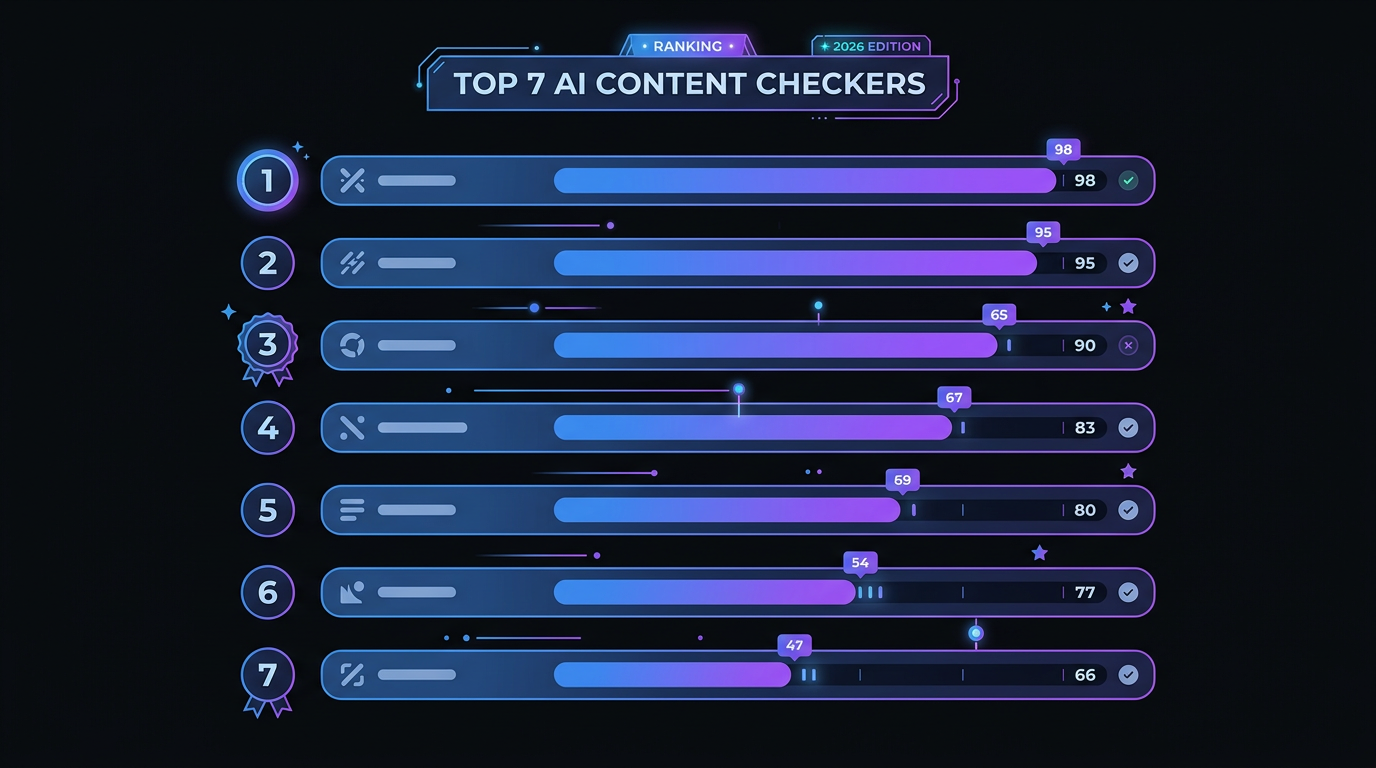 Our ranking of the best AI content checkers for 2026 is based on accuracy, features, and pricing for different use cases.
The 7 Best AI Content Checkers, Ranked
1. GPTZero
Best for: Educators and general-purpose detection
GPTZero originated from a Princeton University senior thesis project by Edward Tian and has grown into the most widely cited AI detector on the market. G2 ranked it the number one most trusted AI tool in 2025, above Grammarly.
What it does well:
- Sentence-level highlighting that shows exactly which passages triggered detection
- 99.3% overall accuracy in GPTZero's own benchmark testing against Copyleaks (90.7%) and Originality.ai (source)
- Batch file uploads for checking multiple documents at once
- Browser extension for real-time checks on any webpage
- Classroom integrations for Canvas, Google Classroom, and more
Pricing: Free tier includes 10,000 words/month and 5 advanced scans. Paid plans start at $10/month (Essential) and $16/month (Premium).
Limitations: Flags non-native English writing as AI-generated at a higher rate than competitors, which has been a consistent criticism in academic settings. Also less reliable on text under 100 words.
Verdict: The best free starting point. If you check content occasionally, the free tier covers it. Educators will get the most value from the classroom features.
2. Originality.ai
Best for: Content agencies and publishers
Originality.ai combines AI detection with plagiarism checking, readability scoring, and fact-checking in a single interface. It was one of the first tools to market directly to SEO agencies after Google's 2023 guidance on AI content.
What it does well:
- Combined AI detection + plagiarism scanning in one pass
- Team management with role-based access for editorial workflows
- API access for integrating detection into CMS platforms
- Chrome extension for checking any page on the fly
- Shareable reports for client-facing communication
Pricing: Pay-as-you-go at $0.01 per credit or subscriptions starting at $14.95/month for 2,000 credits. One credit covers roughly 100 words.
Limitations: No free tier. The credit model adds up fast if you're scanning long-form content daily. A 2,000-word article costs about 20 credits, so the base subscription covers roughly 100 articles per month.
Verdict: The best option for agencies managing freelancer submissions. The combined plagiarism + AI check saves time in editorial workflows. Budget-conscious solo operators should look elsewhere.
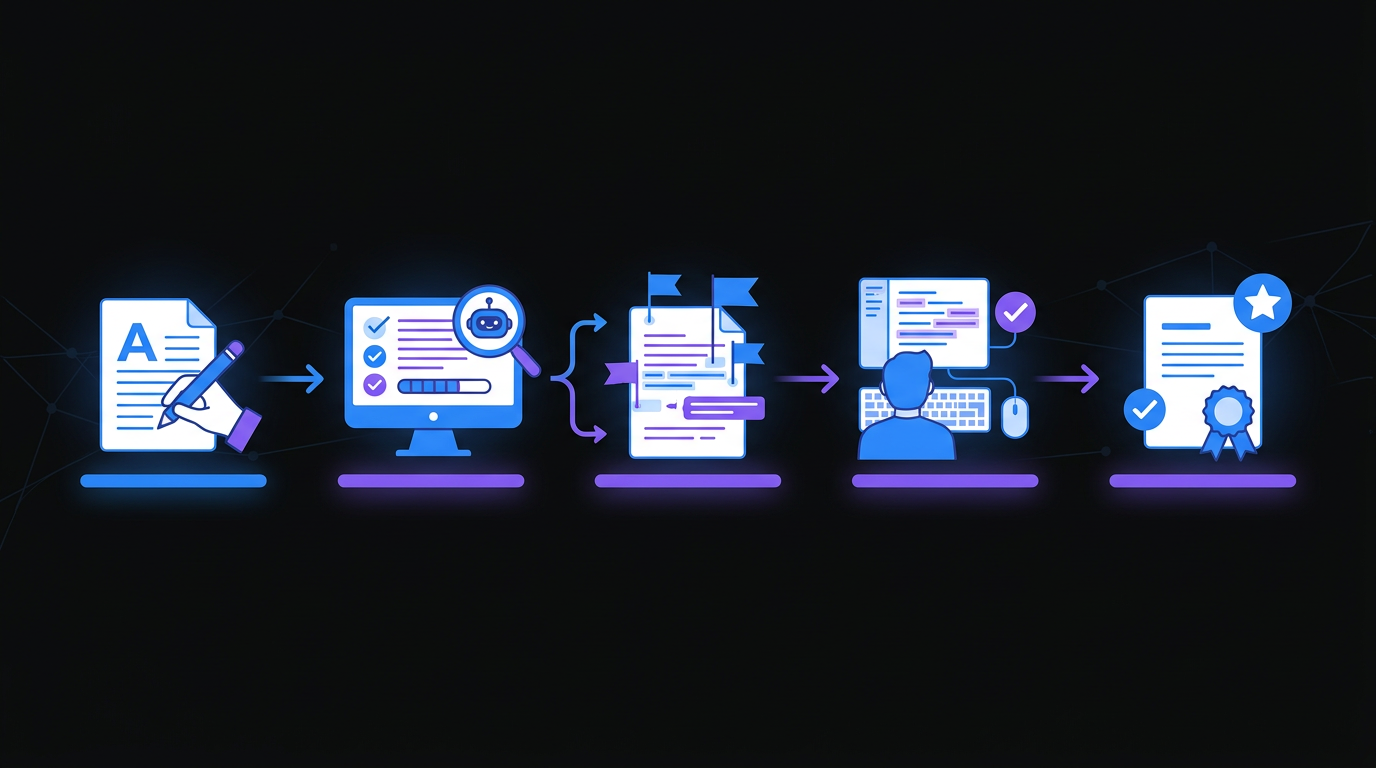 Implementing an AI checker into your editorial workflow helps maintain content quality and authenticity across your publication.
3. Slop Detector
Best for: Quick quality scoring with a clear grading system
Slop Detector takes a different approach from most AI content checkers. Instead of a binary "AI or human" output, it runs text through pattern analysis and returns two things: a 0-100 numerical score and a letter grade from A (clearly human) to F (obvious AI slop).
What it does well:
- A-F letter grading makes results immediately actionable without interpreting probability percentages
- 0-100 scoring for granular comparison between drafts
- 10 free scans per day with no account required
- Shareable result links for sending reports to clients or team members
- Fast: results in under 3 seconds for most text
Pricing: Free (10 scans/day). No credit card required.
Limitations: Newer tool with a smaller training dataset than GPTZero or Originality.ai. No batch processing yet. No plagiarism checking. Works best on English-language content over 150 words.
Verdict: The fastest way to gut-check a piece of content. The letter grade system is genuinely useful. When a client asks "is this article AI-generated?" you can share a link showing a C+ grade instead of trying to explain a 67.3% probability score. The 10 free daily scans cover most individual workflows without paying anything.
4. Copyleaks
Best for: Enterprise teams and multilingual content
Copyleaks positions itself as enterprise-grade, and the feature set backs that up. It supports 30+ languages and holds SOC 2 compliance certification.
What it does well:
- Broadest language support in the market (30+ languages)
- LMS integrations for Moodle, Canvas, Blackboard
- Source code detection for AI-generated programming
- SOC 2 compliance for regulated industries
- Detailed reports with confidence scores per sentence
Pricing: Personal plans at $13.99/month for 1,200 credits (1 credit = 250 words). Enterprise pricing is custom.
Limitations: The per-credit pricing gets expensive for high-volume users. Business Insider ranked Copyleaks as the best overall AI detector (September 2025), but independent testing by GPTZero showed it at 90.7% accuracy vs. GPTZero's 99.3% on the same dataset. Results vary by test methodology.
Verdict: The right choice for organizations that need compliance certifications, multi-language support, or LMS integration. Overkill for individual creators.
5. ZeroGPT
Best for: Free, no-signup checks
ZeroGPT is the simplest tool on this list. Paste text, click a button, get a result. No account needed.
What it does well:
- Completely free with no registration
- Clean interface with zero friction
- Handles text up to 15,000 characters per scan
- Claims analysis of 20M+ articles in training data
Pricing: Free.
Limitations: Multiple independent reviews flag ZeroGPT for a high false positive rate. A 2025 review by AcademicHelp.net found it "not the most trustful AI detection service" with notable reliability issues (source). Skywork AI's analysis similarly noted "notable false positives and easy evasion with paraphrasing or editing" (September 2025). UK guidance from Jisc explicitly advises against using any single AI detector as sole evidence in academic misconduct cases.
Verdict: Fine for a quick sanity check. Do not use as your only verification tool. Cross-reference with GPTZero or another option.
6. Sapling AI Detector
Best for: Lightweight API integration
Sapling targets developers and product teams who want to embed AI detection into existing applications.
What it does well:
- Clean REST API with sub-second response times
- Simple per-token pricing
- Easy integration with helpdesks, CRMs, and content platforms
- Sentence-level scoring
Pricing: Free tier for low volume. Paid plans based on usage.
Limitations: Less accurate on creative or informal writing. Designed more for programmatic access than end-user workflows.
Verdict: Best for teams building detection into their own products. Not the right choice for manual content review.
7. Writer AI Content Detector
Best for: Teams already using Writer.com
Writer.com is an AI writing platform with a built-in detector. The detection feature works within their broader content governance framework.
What it does well:
- Integrated with Writer's style guide enforcement and terminology management
- Team collaboration features built in
- URL-based checking (paste a link, get a score)
Pricing: Starts at $18/user/month. Enterprise plans available.
Limitations: You're paying for the full Writer platform even if you only want detection. Standalone accuracy sits around 82% in third-party testing, below dedicated detectors.
Verdict: Only makes sense if your team already uses Writer.com for content creation. Otherwise, you're overpaying for detection alone.
Quick Comparison Table
| Tool | Free Tier | Pricing (Paid) | Best Feature | Ideal User | |------|-----------|-----------------|-------------|------------| | GPTZero | 10K words/month | $10-16/mo | Sentence-level highlights | Educators | | Originality.ai | None | $14.95+/mo | AI + plagiarism combo | Agencies | | Slop Detector | 10 scans/day | Free | A-F grading system | Solo creators | | Copyleaks | Limited | $13.99+/mo | 30+ languages | Enterprise | | ZeroGPT | Unlimited | Free | Zero friction | Quick checks | | Sapling | Low volume | Usage-based | API integration | Developers | | Writer | None | $18/user/mo | Style governance | Writer.com users |
How to Actually Use an AI Content Checker (Practical Workflow)
Running text through a detector is step one. Here's the workflow I use for editorial review:
Step 1: Run the scan. Paste the full text into your preferred tool. Start with Slop Detector for a fast A-F grade, then cross-reference anything scoring below B with GPTZero.
Step 2: Check the flagged sections. GPTZero's sentence-level highlighting is useful here. Not every flagged sentence means the whole piece is AI-generated. Technical writing, legal language, and formulaic content (recipes, product specs) naturally trigger detectors.
Step 3: Look for the tells manually. AI text has patterns that detectors sometimes miss: overuse of transition phrases ("Furthermore," "Moreover," "It's worth noting that"), lists that sound comprehensive but lack specific numbers or dates, paragraphs that summarize without adding new information, and absence of first-person experience or concrete examples.
Step 4: Make the call. No detector replaces human judgment. A piece scoring 60% AI probability is a non-native English speaker's genuine work in some cases. A piece scoring 20% is AI content that was heavily paraphrased in other cases. Use the tools as signals, not verdicts.
What AI Content Checkers Get Wrong
Current AI detection tools can achieve over 95% accuracy on unedited AI text but drop to 60-70% accuracy on AI text that has been even lightly revised by a human editor, according to ZDNET's 2025 detector review citing University of Maryland research. This is the fundamental limitation.
The tools work well for catching lazy, unedited AI output. They struggle with AI-assisted writing where a human uses AI for a first draft then rewrites heavily, non-native English text that happens to have low burstiness patterns, technical and legal writing with standardized phrasing, and short samples under 150 words (not enough signal for reliable classification).
Europol's 2024 report projected that 90% of online content could be AI-generated by 2026 (source). If that projection holds, the question shifts from "was this written by AI?" to "was this written well?" That's where the grading approach (like Slop Detector's A-F system) becomes more useful than a binary human/AI classification.
Frequently Asked Questions
What is the best free AI content checker in 2026?
GPTZero offers the best free tier for text analysis, providing 10,000 words per month with sentence-level highlighting and zero false positives on human text in controlled testing. Slop Detector is the best free option for website-level analysis, scanning entire URLs with no account required and achieving 92-97% accuracy. ZeroGPT is completely free with unlimited checks but has higher false positive rates documented in multiple 2025 independent reviews.
How accurate are AI content checkers in 2026?
The most accurate tools achieve 94-99% on clearly human or clearly AI text. GPTZero claims 99.3% accuracy in its own benchmark testing. Originality.ai scored 100% detection on major AI models in our testing. Copyleaks holds 90.7% in GPTZero's comparative testing. All tools drop significantly on edited AI content: University of Maryland CLIP lab research shows accuracy falls to 60-70% on AI text that has been even lightly revised by a human editor.
Can Google detect AI-generated content?
Google does not publicly confirm specific AI detection mechanisms in its ranking algorithms. Google's March 2024 Search Quality Rater Guidelines focus on whether content demonstrates experience, expertise, authoritativeness, and trustworthiness (E-E-A-T), regardless of how it was produced. Sites publishing mass-produced AI content without human review risk penalties under the helpful content system, but well-edited AI content that meets E-E-A-T standards is not categorically penalized.
What are the main signs of AI-generated content?
The most reliable signs include overuse of transition phrases like "furthermore," "moreover," and "it is important to note"; uniform sentence length without natural rhythm variation; hollow conclusions that restate the introduction without adding new insight; generic examples with no specific companies, dates, or numbers cited; perfect grammar with no fragments or natural errors; and a complete absence of personal anecdotes or first-hand experience. These patterns stem from how AI models optimize for smooth, predictable output rather than authentic human voice.
Should I use AI content checkers to discipline writers or students?
No. AI content checker scores should never be used as the sole basis for disciplinary action against writers or students. UK guidance from Jisc, ACM policy, and GPTZero's own documentation all explicitly caution against this. False positives affect non-native English speakers disproportionately. The appropriate use is as a signal for closer human review, not as proof of misconduct. Combine detection scores with direct conversation about the writer's process and review of specific flagged passages.
Which AI content checker is best for a content marketing agency?
Originality.ai is the top choice for content marketing agencies because it combines AI detection with plagiarism checking in one credit, includes team management with role-based access, offers shareable client reports, and provides API integration for CMS workflows. At $14.95 per month for 2,000 credits (roughly 100 articles), it's cost-effective for agencies processing regular freelancer submissions. Slop Detector complements it for URL-based audits of client domains or competitor sites.
Bottom Line
For most people, start with GPTZero's free tier for general detection and Slop Detector for fast quality grading. If you run an agency, Originality.ai justifies the subscription cost with its combined AI + plagiarism checking. Enterprise teams with compliance requirements should evaluate Copyleaks.
Skip ZeroGPT for anything high-stakes. Use Writer only if you're already on their platform. And regardless of which tool you pick: cross-reference results, check flagged sections manually, and never fire a writer based on a single detector score.
The AI content problem is not going away. But with the right tools and a realistic understanding of their limits, you can filter signal from slop.
Related Articles
Losing 10+ hours a week to manual work?
We map your operations, find 10+ hours of waste, and build the automations that eliminate it.
Book a Free Intro Call