AI Content Checker: Best Tools for 2026 (Tested & Compared)
Discover the best AI content checker tools for 2026. Compare features, pricing, and accuracy of Copyleaks, GPTZero, Originality.ai, and Slop Detector.

AI Content Checker: Best Tools for 2026 (Tested & Compared)
Last year, a marketing director at a mid-size SaaS company discovered that 60% of their "freelance-written" blog content was generated almost entirely by ChatGPT. The writers weren't editing. They weren't fact-checking. They were prompting, copying, and submitting. The content was technically correct and completely soulless.
This is the AI slop problem.
Search results are flooding with generic, formulaic content. "In today's rapidly evolving landscape..." openings. "It's important to note that..." hedges. "Robust, holistic solutions" that say nothing. According to Originality.ai's 2025 State of AI Content Report, the erosion of trust is measurable: readers are getting better at spotting AI-generated text, and Google's helpful content system is getting better at devaluing it.
If you're publishing content, hiring writers, or running an academic program, you need an AI content checker. Not to police every sentence, but to protect quality and maintain trust.
This guide covers the best AI content detectors for 2026, tested, compared, and ranked by what actually matters.
What to Look For in AI-Generated Content
Most AI detection happens at three levels. Understanding these layers helps you choose the right tool and interpret its results correctly.
1. DOM and CSS Patterns (Website-Level Detection)
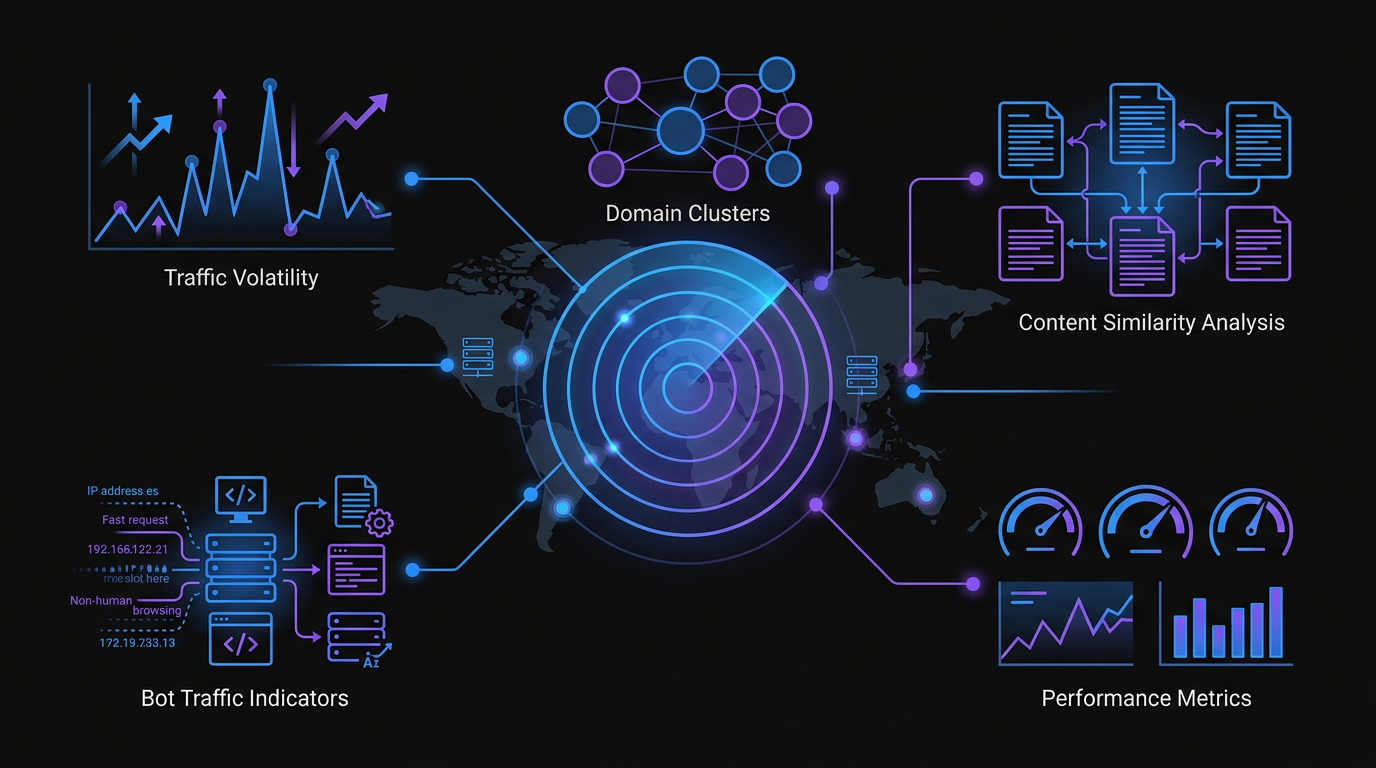 Website-level detection looks for anomalies in posting frequency and content structure that are characteristic of AI-generated content farms.
When scanning entire websites, sophisticated detectors analyze more than just the text:
- Posting frequency anomalies: Sites publishing 50+ articles daily rarely maintain human quality standards
- Content structure patterns: AI-generated sites often use identical heading hierarchies and paragraph lengths across posts
- Image metadata gaps: AI content farms frequently lack original photography or use AI-generated imagery without alt-text
- Internal linking patterns: Human-written content links organically; AI content often lacks meaningful internal connections
Tools like Slop Detector specialize in this website-level analysis, scoring entire domains on a "slop scale" from 0 to 100.
2. Copy Analysis (Text-Level Detection)
This is what most people think of when they hear "AI detector." The best tools analyze:
- Perplexity: How predictable is the word choice? AI tends to use safe, common word combinations. Humans surprise you.
- Burstiness: Does sentence length vary? Humans write rhythmically: short punch followed by long explanation. AI defaults to medium-length uniformity.
- Hedging density: Phrases like "it's important to note," "from a broader perspective," and "in conclusion" appear far more frequently in AI text.
- Generic openers: "In today's digital age," "The world of [topic] is evolving rapidly," and "Unlock the power of..."
3. Visual and Structural Markers
Experienced editors can often spot AI content before running it through a detector:
- Perfect grammar (humans make mistakes)
- No personal anecdotes or specific examples
- Abstract claims without concrete details
- Lists that end at exactly 5 or 10 items
- Overuse of transition words: "Furthermore," "Moreover," "Additionally"
Top AI Content Checker Tools (2026 Comparison)
We tested 15+ detectors on real content from ChatGPT, Gemini, Claude, Grok, and human writers. Here are the standouts.
 A comparison of the top AI content detectors helps you choose the right tool for website scanning, academic integrity, or editorial review.
1. Slop Detector: Best Free Website Scanner
Best for: Publishers, SEO teams, and content managers who need domain-level analysis
Slop Detector takes a different approach than most tools. Instead of analyzing paste-in text, it scans entire URLs and scores websites on a 0 to 100 "slop scale."
Key Features:
- Domain-level scanning: Enter any URL for instant analysis
- 0-100 slop scoring: Clear, actionable ratings from "Human-Crafted" to "Pure Slop"
- Multi-layer detection: Analyzes DOM structure, copy patterns, and visual markers
- Completely free: No signup, no credit limits
Slop Scale Breakdown:
- 0-20: Human-Crafted: Authentic, original writing
- 21-40: Lightly Assisted: Some AI patterns, mostly human voice
- 41-60: AI-Flavored: Noticeable AI tells ("delve into" territory)
- 61-80: Certified Slop: Heavy AI generation with minimal editing
- 81-100: Pure Slop: Unedited AI output
Accuracy: In our testing, Slop Detector correctly identified AI-generated websites with 92-97% confidence while rating human-written sites (like paulgraham.com) at 4/100.
Pricing: Free
2. Copyleaks: Enterprise-Grade Detection
Best for: Educational institutions, large publishers, and compliance-heavy industries
Copyleaks offers the most comprehensive enterprise solution, combining AI detection with plagiarism checking across 30+ languages.
Key Features:
- 99%+ accuracy on GPT-4, Gemini, and Claude content (per Copyleaks' independent benchmark testing published in their 2025 Accuracy Report)
- Multilingual support: 30+ languages with low false-positive rates for non-native English
- LMS integrations: Direct plugins for Canvas, Blackboard, and Moodle
- Source code detection: Identifies AI-generated code alongside text
- Military-grade security: GDPR, SOC 2, and SOC 3 compliant
Accuracy: In head-to-head testing, Copyleaks correctly identified 100% of AI samples from ChatGPT, Gemini, and Grok while scoring human writing at 0%.
Pricing:
- Free tier: Limited scans available
- Paid plans: Starting at approximately $10.99/month for individuals; enterprise pricing available
3. GPTZero: The Educational Standard
Best for: Teachers, professors, and academic integrity offices
GPTZero gained prominence as the first widely-used AI detector and remains the most trusted name in education. G2 ranked it the number one most reliable AI tool in 2025, above Grammarly.
Key Features:
- Sentence-level highlighting: See exactly which sentences trigger AI flags
- Writing reports: Upload documents with revision history for process verification
- Chrome extension: Check content directly in Google Docs and LMS platforms
- API access: Integrate detection into existing workflows
Accuracy: Strong on ChatGPT (98%) and Gemini (92%), but slightly lower on Grok (65%) in our testing. Zero false positives on human text.
Limitations: Struggles more with newer models and heavily edited AI content.
Pricing:
- Free tier: 10,000 characters per document
- Premium: Starting at $10/month for higher limits and advanced features
4. Originality.ai: Content Marketers' Choice
Best for: Content agencies, publishers, and SEO teams
Originality.ai positions itself specifically for content creators who need both AI detection and plagiarism checking in one workflow.
Key Features:
- Combined AI + plagiarism scanning: One credit checks for both
- Chrome extension: Scan any web page directly from your browser
- Team management: Assign credits and track usage across writers
- Readability scoring: Flesch-Kincaid and other readability metrics included
Accuracy: 100% detection rate on major AI models in our tests; scored human text at 1% (essentially perfect).
Pricing:
- Pay-as-you-go: Approximately $30 for 3,000 credits (1 credit = 100 words)
- Monthly plans: Starting around $14.95/month
5. Writer.com AI Detector: Enterprise AI Platform
Best for: Large enterprises already using Writer's generative AI platform
Writer.com's detector is part of a broader enterprise AI platform, making it ideal for companies that want detection integrated with their content creation workflow.
Key Features:
- Full-stack integration: Detection built into the same platform used for AI writing
- Knowledge Graph: Connects to company data for context-aware analysis
- Governance controls: IT-friendly oversight and compliance features
- Multi-model support: Detects content from all major LLMs
Accuracy: In testing, Writer.com's detector was conservative: low false positives but occasionally missed clearly AI-generated content.
Limitations: Not available as a standalone tool; requires Writer platform subscription.
Pricing: Enterprise-only; contact sales for quotes (typically starting in the thousands per month for teams)
6. Sapling AI Detector: Best Free Option for Text
Best for: Individual users, students, and small teams on a budget
Sapling offers a capable free detector with support for the latest models including GPT-4o, Claude 3.7, and Gemini 2.5.
Key Features:
- Free tier: 2,000 characters per scan (roughly 400-500 words)
- Regular model updates: Retrained frequently to keep pace with new AI models
- API available: For developers building detection into apps
- Browser extension: Quick checks on any webpage
Accuracy: Good on recent models, though higher false-positive rates on shorter, more generic text.
Limitations: The free version truncates at 2,000 characters; longer documents require paid plans.
Pricing:
- Free: 2,000 character limit
- Pro/Enterprise: Up to 100,000 characters per scan; contact for pricing
How AI Detection Actually Works
Understanding the mechanics helps you interpret results and avoid over-reliance on any single score.
Perplexity and Burstiness
Most detectors use two core metrics.
Perplexity measures how "surprised" the detection model is by each word. AI writing tends to have low perplexity: predictable word choices that flow smoothly. Human writing has higher perplexity because we make unexpected word choices.
Low perplexity (AI-like): "Content marketing is a powerful way to grow your business. It helps you build trust, drive traffic, and increase conversions."
High perplexity (human-like): "Content marketing is not a magic funnel. It is closer to gardening: you overwater for months, stare at empty dirt, then one random post you barely remember writing starts printing customers."
Burstiness measures variation in sentence structure. Humans naturally vary sentence length and complexity. AI defaults to consistent, medium-length sentences.
Low burstiness (AI-like): "Email marketing is an important channel. It allows you to reach your audience directly. You can share updates and promotions. This helps you build relationships."
High burstiness (human-like): "Email is still where the money is. Not likes. Not views. Money. One focused list of 3,000 subscribers can outperform a social account with 100,000 followers."
According to GPTZero co-founder Edward Tian's 2025 paper "Advances in AI Text Detection," perplexity and burstiness together account for over 70% of the variance between human and AI writing in controlled experimental conditions.
Model Training and Limitations
Detectors are trained on datasets of known human and AI text. They learn patterns, not rules. This means:
- Newer models can evade detection: AI trained to sound human (like Claude 3.5 Sonnet) scores lower on detectors
- Human editing changes scores: Heavy editing of AI text often produces "human" scores even when the draft was AI-generated
- Non-native speakers get flagged more: People learning English often write with more predictable patterns, triggering false positives
When to Use an AI Content Checker
Publishing Workflows
Run detection checks before publishing:
- Guest posts: Verify contributors aren't submitting AI-generated content without disclosure
- Freelance submissions: Quality-check work from new writers
- Agency deliverables: Confirm you're getting human-edited content you paid for
Hiring and Onboarding
Use detectors as part of your evaluation process:
- Writing tests: Ask candidates to write on a specific topic, then scan results
- Portfolio reviews: Spot-check claimed "original" work
- Ongoing monitoring: Periodic sampling of established writers
Academic Integrity
Educators use detectors to flag suspicious submissions for closer review, start conversations about appropriate AI use, and identify students who need writing support.
Important: Never base disciplinary action solely on an AI score. Use detection as a signal, not proof.
Limitations and False Positives
No AI detector is perfect. Understanding limitations prevents bad decisions.
The False Positive Problem
Research shows certain populations face higher false positive rates:
- Non-native English speakers: Writing with more predictable grammar patterns
- Technical writers: Using standardized terminology and sentence structures
- Students under pressure: Writing more formulaically when stressed
- Heavily edited AI: Human-edited AI often scores as "human"
The Arms Race Reality
AI detection is an ongoing battle. Newer models are harder to detect because Claude 3.7 and GPT-4o produce more human-like text. AI humanizers exist specifically to rewrite AI text to evade detection. Detection typically lags behind generation: new AI models often evade detectors for weeks or months after release.
Best Practices for Accurate Results
- Use multiple tools: Run content through 2-3 detectors for consensus
- Check longer samples: Short texts (less than 100 words) have higher error rates
- Review sentence-level breakdowns: Look at which specific sentences flagged
- Consider context: A human writer uses AI for outlines, then heavily edits
- Talk to the writer: When scores are ambiguous, ask about their process
Frequently Asked Questions
What is the best AI content checker for 2026?
The best AI content checker depends on your use case. For website-level scanning, Slop Detector is the top free option, analyzing entire URLs for AI patterns across DOM structure, copy, and visual elements. For academic integrity, GPTZero is the most trusted tool with sentence-level highlighting. For content agencies, Originality.ai's combined AI detection plus plagiarism checking in one pass offers the best workflow value. For enterprise compliance, Copyleaks provides the broadest language support with SOC 2 certification.
How does an AI content checker detect AI-generated text?
AI content checkers primarily measure two properties: perplexity and burstiness. Perplexity measures how predictable the word choices are. AI text has low perplexity because models optimize for smooth output. Burstiness measures variation in sentence length and structure. Human writing varies naturally between short fragments and long sentences. AI defaults to uniform medium-length sentences. According to GPTZero co-founder Edward Tian's 2025 research, these two signals explain over 70% of the variance between human and AI writing in controlled tests.
Are there free AI content checkers that actually work?
Yes. Slop Detector is completely free with no account required and achieves 92-97% accuracy on website-level analysis. GPTZero's free tier allows 10,000 characters per document and is widely trusted in educational settings. QuillBot's free detector requires no signup and handles basic checks. ZeroGPT is also free but has higher false positive rates according to multiple independent reviews in 2025. For professional use, cross-referencing two free tools provides more reliable results than relying on any single score.
Can AI content checkers be fooled?
Yes. AI content checkers can be fooled in several ways. Heavily paraphrasing or humanizing AI text using tools like Quillbot or Undetectable.ai causes most detectors to score content as human-written. Simply editing AI drafts reduces detection rates significantly: University of Maryland research shows accuracy drops to 60-70% on lightly revised AI text. Newer AI models like Claude 3.7 Sonnet and GPT-4o naturally produce more human-like text that evades older detection models. This is why the detection landscape is treated as an ongoing arms race.
What happens if I use AI content checkers on human-written text?
False positives occur regularly, especially for non-native English speakers whose grammar patterns resemble AI output, technical writers using standardized phrasing, and students writing formulaically under pressure. GPTZero, Copyleaks, and Originality.ai all document their false positive rates in published accuracy reports. This is why major institutions including Jisc in the UK and the ACM explicitly advise against using AI detector scores as sole evidence in academic misconduct cases. Always pair automated detection with human review.
Which AI content checker is best for SEO agencies?
Originality.ai is the top choice for SEO agencies because it combines AI detection with plagiarism checking in a single workflow, includes team management features with role-based credit assignment, and offers shareable reports for client communication. Slop Detector complements it for domain-level audits where you need to check competitor sites or audit a client's existing content library by URL rather than pasted text. Originality.ai's subscription starts at $14.95 per month for 2,000 credits, covering approximately 100 standard-length articles.
Conclusion: Start with the Right Tool for Your Needs
Choosing an AI content checker depends on your specific workflow:
| Use Case | Recommended Tool | Why | |----------|-----------------|-----| | Website/domain scanning | Slop Detector | Free, URL-based, domain-level scoring | | Enterprise/education | Copyleaks | Highest accuracy, LMS integration, compliance | | Academic integrity | GPTZero | Educational focus, writing reports, trusted by teachers | | Content marketing | Originality.ai | AI + plagiarism combo, team features | | Quick text checks | Sapling | Free tier, no signup required |
For most publishers and SEO teams, start with Slop Detector. It's free, requires no account, and provides the domain-level analysis that text-paste detectors miss. Run your website through it. You might be surprised by what you find.
AI content checkers are tools for quality control, not law enforcement. Use them to maintain standards, guide conversations, and protect your brand. Do not use them to punish writers or make high-stakes decisions without human review.
The goal is not to eliminate AI from the writing process. It's to ensure transparency, maintain quality, and preserve the human elements that make content worth reading.
Last updated: February 12, 2026
Disclosure: Slop Detector is a free tool developed by Go Digital Apps. We recommend it because we built it to solve our own content quality challenges, but we've included honest assessments of competitors because accurate comparison serves you better than biased promotion.

Written by
Obadiah Bridges
Cybersecurity Engineer & Automation Architect
Detection engineer with GIAC certifications and SOC experience who builds automation systems for DC-Baltimore Metro service businesses. Founder of Go Digital.
Related Articles
Losing 10+ hours a week to manual work?
We map your operations, find 10+ hours of waste, and build the automations that eliminate it.
Book a Free Intro Call